
Skip to content

AI Solution

MATE-AI for ADUP

Anomaly Detection Universal Platform · Universal anomaly detection platform

Overview

Product Overview

MATE-AI for ADUP combines generative AI with a general-purpose platform, so it can be applied across a wide range of industries.

ADUP addresses the unstructured defects and false rejects that rule-based vision inspection cannot handle, and its generative AI techniques and general-purpose platform extend to other industries and product types with reliable, efficient results.

ADUP General-purpose anomaly detection platform
  • Image processing
    • Image enhancement using filters such as homomorphic and HE
    • Higher anomaly detection accuracy through image processing
  • Transfer learning
    • Models built to fit specific demand
    • New models created and validated from pre-trained models, for other industries and other parts
  • Dataset construction
    • Generative AI based augmentation (GAN)
    • Transform techniques applied
  • Visualization
    • Visualization of defect detection
    • Visualization of model evaluation
    • Inspection process monitoring
  • Model management
    • New models generated through periodic retraining
    • Models compared, with the best one deployed

Features

Key Features

  • 01

    Dataset construction

    Dataset construction based on generative AI

  • 02

    Profile management

    Broad rollout through a profile management system

  • 03

    Transfer learning

    Greater efficiency through transfer learning

  • 04

    Visualization

    Model management (MLOps) and visualization
MATE-AI for OPC

Optimal Process Conditions · AI solution for optimal process conditions

Overview

Product Overview

MATE-AI for OPC (Optimal Process Conditions) uses AI to determine and supply the optimal settings for equipment.

As an AI solution for optimal process conditions, the model predicts quality from equipment data and returns optimal process values in real time, laying the groundwork for a digital twin.

XGBoost

Data set  X Tree1{X, θ1} …… Tree2{X, θ2} …… Treek{X, θk} …… …… Node splitting by objective function f1(X, θ1) f2(X, θ2) fk-1(X, θk-1) fk(X, θk) …… Residual Residual Residual fk(X, θk)

MLP

Input Layer Hidden Layer Output Layer Xm yp
Real-time equipment data

Quality prediction

Prediction model
Defect decision
  • Good
  • Defective

Optimal conditions

Optimal condition model
Optimal equipment values derived

Features

Key Features

  • 01

    Real-time monitoring

    Real-time monitoring of process data

  • 02

    Optimal condition values

    Optimal condition values proposed for each process

  • 03

    Defect decision

    Defect decisions across key processes

  • 04

    Lower defect rate

    Fewer defects by preventing human error

MATE-AI for QP

Quality Prediction · AI solution for quality prediction

Overview

Product Overview

MATE-AI for QP (Quality Prediction) uses process data to deliver AI-based quality prediction.

As an AI solution for quality prediction, a model trained on process data returns predicted quality values for live process data, and built-in training management lets the solution keep improving over time.

CloudLocal

Model retraining

DBMS

Visualization

Quality prediction model

Features

Key Features

  • 01

    Data collection

    Process data collection and monitoring

  • 02

    Quality prediction

    Real-time quality prediction from process data

  • 03

    Prediction history

    Review of AI prediction history

  • 04

    Data analysis

    Data analysis using EDA

MATE-AI for TMS

Test Management System

Overview

Product Overview

MATE-AI for TMS (Test Management System) provides end-to-end test monitoring with AI-based scheduling.

As a test management system, it monitors utilisation and performance for each piece of test equipment against an AI-generated plan, and aggregates and analyses results automatically with deep learning for reliable test execution.

  1. 01 Test request
    • Master data
    • Test type
    • Test conditions
    • Special notes
  2. 02 Test intake
    • Review of test details
    • Review of the schedule
    • Intake confirmed
  3. 03 Test execution
    • Test environment setup
    • Status monitoring
    • Test data collection
    • Results produced
  4. 04 Test closure
    • Report issued
    • Requester notified

Strengths

Highlights

  • Test management

    Adopting a test management system brings test data into a single system

  • Faster decisions

    Quantified, visible test data supports faster decision making

  • Better communication

    Sharing live test status improves communication between departments

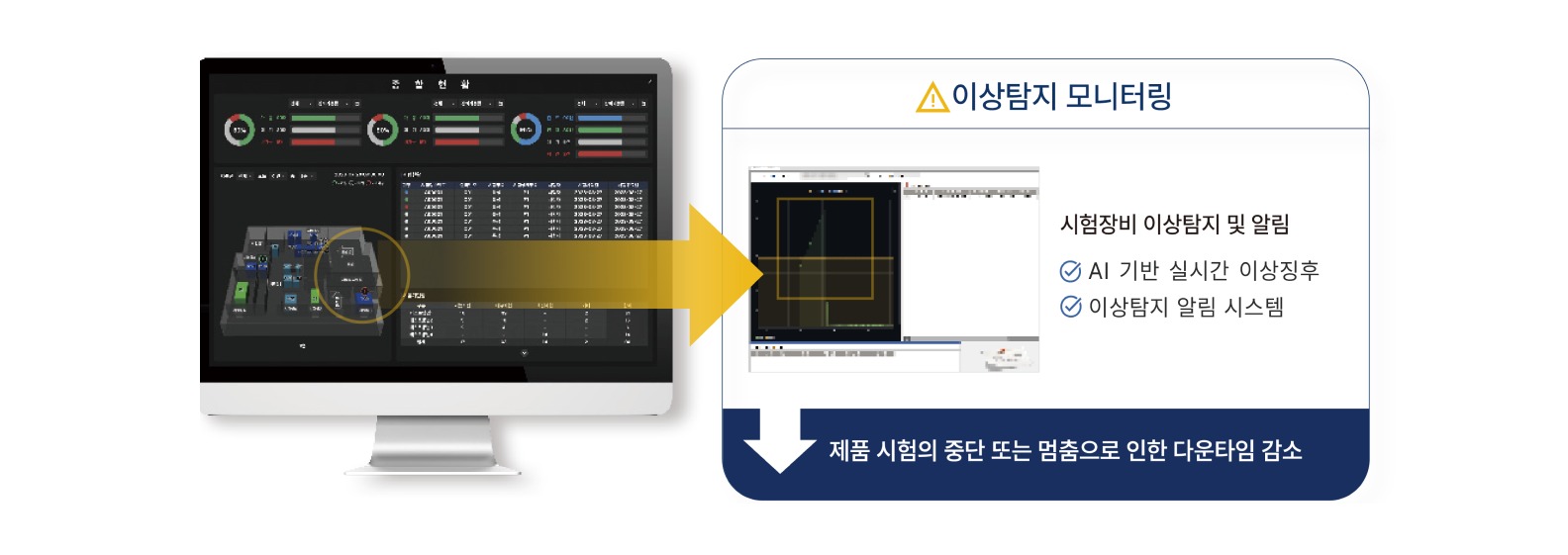
  • Anomaly prediction and response

    Live monitoring of test equipment prevents problems in advance and enables immediate response, cutting lost time from interrupted or halted testing and freeing up test capacity

  • Real-time response

    Live monitoring establishes an immediate response path for equipment faults, abnormal results and emergencies

Features

Key Features

  • 01

    Optimal scheduling

    AI-based optimal scheduling of test plans

  • 02

    Visualization

    Quantification and visualization of test data

  • 03

    Data collection

    Automatic collection of test results using deep learning

  • 04

    Anomaly response

    Response to equipment faults and emergencies

  • 05

    Request management

    Request intake and management

  • 06

    Test management
    • Test monitoring and test instruction management
    • Master data: test standards and test plans
    • Results: test record enquiry and management
  • 07

    Equipment management
    • Equipment monitoring and anomaly analysis
    • Master data: jigs, test equipment, components and inspection standards
    • Preventive maintenance: daily checks, maintenance and calibration
  • 08

    Sample management

    Sample management

MATE-CPS

Cyber-Physical System

Overview

Product Overview

MATE-CPS (Cyber-Physical System) builds a 3D virtual site closely matching the real production floor and keeps it synchronised with live process data collected there, and visualises and monitors operating status, and alerts on abnormal conditions make the manufacturing process easier to manage.

MATE-CPS processes and integrates equipment, sensor and production data collected from the process, then converts the physical model of the production system into a virtual model for manufacturing process monitoring. Visibility through the virtual site and data monitoring, reliability from alerts that surface problems early enough to respond well, and a live view of the whole manufacturing processsupport interaction with the plant.

Strengths

Highlights

  • 3D plant model

    A 3D plant closely matching the real site

  • Easier to recognise plant elements

    Actual plant components are easy to identify

  • Clear view of plant status

    Real-time data makes the overall state easy to read

  • Flexible layout

    Users can change the layout when equipment moves

System Flow

System Flow

MES
  • PLC
  • IoT
OPENAPI
Interface Service
  • Data Binding
  • WebSocket
Spring
Unity
  • Object
  • Process monitoring
  • Flexible layout
WebGL
User

Benefits

Benefits

  • Visibility

    3D monitoring gives greater visibility of plant components

  • Interactivity

    Live equipment status supports interaction and a quick read of the whole plant

  • Reliability

    High reliability through fast response to equipment faults and anomalies

  • Usability

    Process layout changes are extensible and practical to make

Considering an implementation?

Tell us about your shop floor and our team will review it and get back to you.